There are no items in your cart
Add More
Add More
| Item Details | Price | ||
|---|---|---|---|

When we read the Mahābhārata, there seems to be a parallel series of boons and curses running alongside the main narrative. Almost every one of the central characters is cursed at some point or they get boons, even Kṛṣṇa, for example from Durvasa and Gandhari. All of this seems to be the norm and the characters take it all in stride mostly, as they should.
However, as the itihāsa has been passed on from generation to generation, some of these boons/ curses have been blown out of proportions and the whole perspective skewed to such an extent that a probable boon appears to be a curse and a probable curse becomes a boon. When reading the Mahābhārata, it is necessary to view such boons/ curses in the context in which they finally become applicable on the individual.
Looking at a few of the key ones:
1) The most heavily skewed one and also the most glorified and perhaps most romanticised one is Sūrya’s boon- the armour and earrings of Karna. The loss of these is highlighted by later authors and local versions of the Mahābhārata heavily and made into a tragic story of its own. But the kavach kundal might not actually be the great boon that they are made out to be.
To begin with, they did not prevent Karna from facing ignominious defeat several times throughout his life. He had them since birth and all his life until he exchanged them for Indra’s Vasavi Shakti. During these years, Karna was defeated in the gurudakshina war, Draupadi swayamvar, against the Gandharvas at Ghosha yatra. Basically, kavach kundal did not guarantee victory for Karna at all but then what was the point of them?
Well, the point is very clear when Kunti GETS it for him- she asks for them from the Sūrya to PROTECT the infant she is abandoning. The kavach kundal are made of amṛta so they protect Karna's life, not his success.
So, by giving them up, what did Karna lose? His ability to fend off death. Now, think about his position at the final battle- he is injured badly, in vital organs and his strength is failing him. His asking Arjuna to stop, adopting delaying tactics like putting his bow aside, trying to lift the wheel out of mud despite his charioteer Shalya being there to do it although minutes back when Kṛṣṇa was lifting HIS chariot out of the mud Karna was shooting arrows at him - they show his desperation. He KNOWS he can't win.
BUT, would Karna want to LIVE after being overcome roundly by Arjuna with the whole Kaurava Pandava army as witness to his defeat?? Defeating Arjuna is his whole life's goal. For Karna it would be unimaginable to live after Arjuna defeats him and then ALLOWS him to keep his life. Death would be far preferable to Karna than to live with the knowledge that his lifelong ambition to defeat Arjuna failed. If he had had the kavach kundal, Karna WOULD have had to live with this ignominy. The absence of Kavach kundal allowed him the dignity of a warrior's death.
Also, Karna intelligently traded off the protective armour for a destructive weapon that was guaranteed to kill his arch enemy- a smart move because his priority was to kill Arjuna, not to protect his own life in the battle with Arjuna. The kavach came in handy as a good negotiating piece in this deal.
Divine kavach- boon or curse?
2) Urvashi's curse to Arjuna is another most famous one. Again, it is described as a curse but is it really? Arjuna never talks about it post the actual cursing phase or complains that he was cursed. He simply takes it in stride. And later, this CURSE becomes a most valuable asset for the Pandavas to hide in Virat's kingdom in disguise. Why? 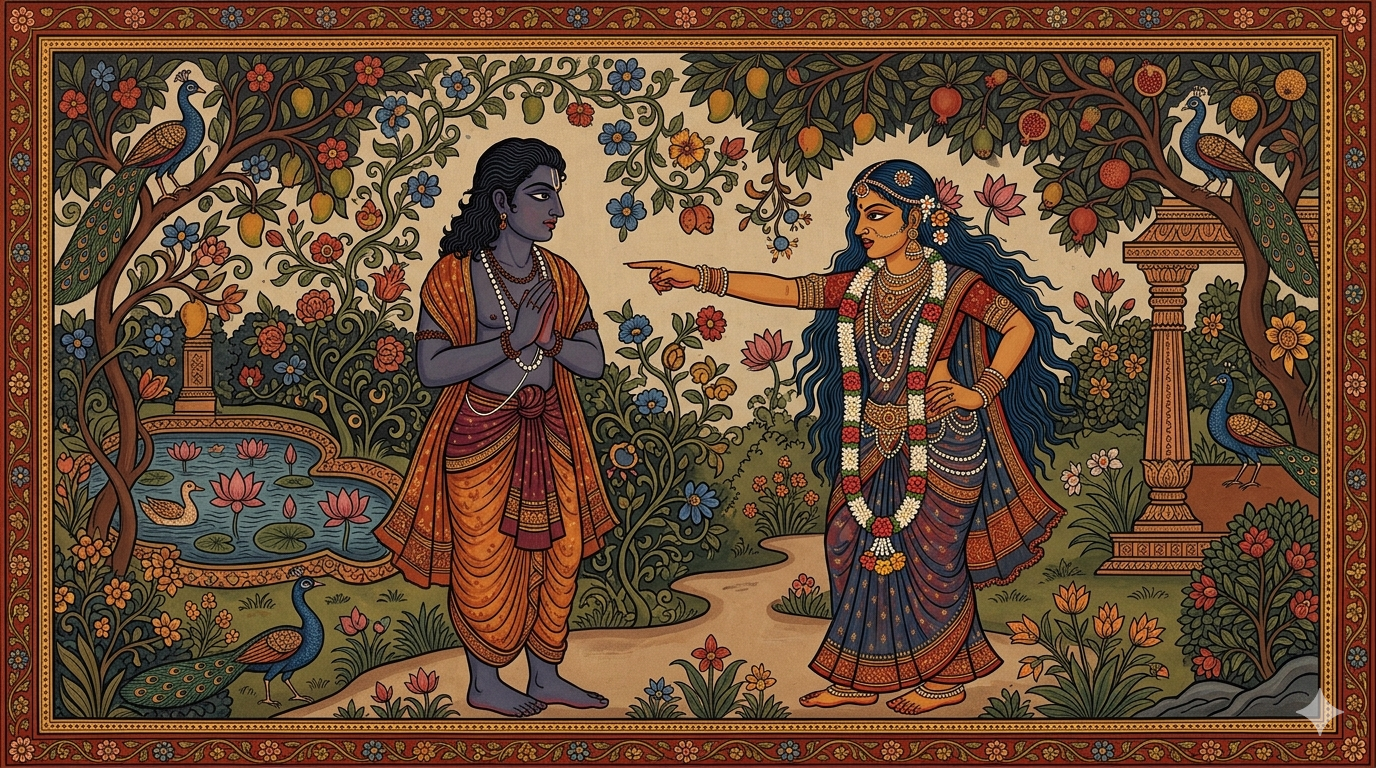
Because it is virtually impossible for Arjuna to hide in his own form, as the other Pandava brothers do. The reason is simple. Arjuna was the most travelled of them all, he had been through almost all of Bharatvarsha on numerous occasions (notably the exile post wedding), wandering through kingdoms and forests and tribes so practically everyone knew him by sight. His deeds were acclaimed widely and were spoken of across kingdoms. In fact, Uttar Kumar has obviously heard of him, and is extremely familiar with all his conquests and his formidable reputation, for he boasts that when he goes out to battle the Kauvara forces, they will wonder if they are facing Arjuna.
Someone would have spotted Arjuna there in Virat’s kingdom if he had NOT been disguised as a eunuch and remained HIDDEN in the inner apartments of the royal family. Urvashi's CURSE turned into a boon or perhaps, Arjuna TURNED the curse into a boon by merely NOT viewing as a roadblock but as an interesting experiment that could be utilized to his advantage.
Urvashi's declaration that Arjuna would spend one year as a eunuch- curse or boon?
3) Longevity/ the ability to choose time of death/ immortality (or close to it)- We have several examples of these peppered throughout the Mahābhārata. Long life/ the option to choose when death approaches would seem to be a boon, on the face of it. However, take Kṛṣṇa cursing Ashwattama to wander the earth for 3000 years. Boon or curse??
Certainly curse. Let's put that aside because he was doomed to be in pain, suffer, wander in loneliness. How about Bhishm?? His ichcha mrutyu boon?? If he had been allowed a natural death, he would never have survived to see Hastinapur fall into such calamity, the children all fight amongst themselves, his clan kill itself. He would never had ended up battling his beloved grandson in a fight until death and then he would not have had to lay on the battlefield more dead than alive watching more slaughter, more destruction and more unfairness take place all around him. And he would not have had to bear the exquisite torture of thousands of arrows piercing through his body for more than a month as he lay waiting for death. Plenty of time to introspect about where all he had gone wrong. Not quite a happy end.
In contrast, at the end of the war, Gandhari cursed Kṛṣṇa that his clan would end in a mere 36 years. 36 years is nothing in the general scheme of things those days when the average life span seems to be about 120- 170 years. Kṛṣṇa accepts this with equanimity, goes about doing his jobs with perfect equanimity too, no change in his actions, thoughts, behaviour. He does not waste the 36 years of life he has in wailing about the curse or in trying to find a way to break it.
As a result, the curse does NOT cloud his entire remaining life, does not tinge/ taint all his actions with sorrow or cynicism, does not make him take a harsher view towards life or his people. The curse just becomes a way for the avtaar to end- a natural end to a complete life, filled with glorious deeds.
In short, the boons and curses in the MB send a powerful message. Whether something is a boon or a curse depends entirely on how YOU perceive it, how you REACT to it. What may be a boon to you, may quickly turn into a curse if you do not utilize it, if you give it ultimate power over yourself. What is a curse can become a boon if you wield it at the right time, in the right way, with the right attitude towards it.

 Launch your Graphy